
We've invested a lot in helping AI find knowledge. But how was the knowledge in our knowledge bases produced in the first place?
From documents back to work
When organizing enterprise knowledge, we naturally start with what we have: reports, meeting notes, and conversation summaries. Reports contain conclusions. SQL captures calculations. A discussion may explain why a metric definition changed. Each artifact is useful, but turning them into something a team can safely reuse requires understanding how they fit together within the same body of work.
Some of those relationships were never recorded. A trial calculation may have led the team to abandon an earlier denominator, while the final report contains only the revised definition. An exclusion condition may have applied to the first round but been removed in the second. Three months later, even an AI given all the files and chats can only infer the reasoning from what survives.
And does every task you do today pass through an agent? If not, what about the changes you make directly, outside the conversation? An AI summary of agent chats cannot capture work that was never discussed there. Those human decisions may be among the most information-dense parts of the process, yet remain invisible to an agent-centric knowledge pipeline.
So what if we preserved the context needed for future knowledge extraction while the work was happening, alongside the artifacts themselves? What should the source unit of analytical knowledge be?
I designed Lantide Workspace as a first-hand source unit for analytical knowledge: a way to access a body of work together with its artifacts, evolution, and evidence.
Let context form as work progresses
A workspace organizes analysis along two dimensions:
- Time: What did the first round investigate? Why did the metric definition change? Which constraints carried into the next round?
- Structure: Which Plan produced a Report? Which SQL and data were used in its formal execution? Which earlier Report informed a later analysis?
Together, these dimensions reveal an artifact's role in the work. A Report may be the output of one round and an input to planning the next. Lantide provides places to record these relationships as work progresses. When an agent changes a managed asset, Change Context can preserve the stated reason and available evidence references. Approved formal queries are retained in the Plan's Steps.
When work context is organized as the work happens, knowledge production no longer has to begin with reconstructing the past.
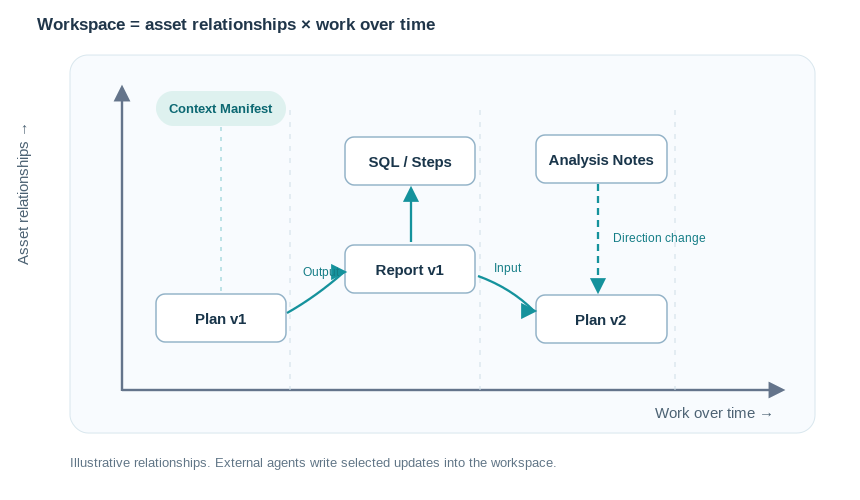
Figure 1. A workspace preserves asset relationships and the course of the work.
A derived knowledge layer
With workspaces as sources, the next question becomes what to select, verify, and generalize. What experience is reusable? What evidence supports it? Does it still apply across different periods, datasets, or business contexts?
Consider refund-rate analysis. “Focus on new customers in this round” is task-specific scope and belongs in the workspace. “Check the business definition of the date field before comparing refund rates across channels” can become a reusable team practice. “Both channels use the refund request date” remains unverified if it is only a stakeholder's statement. Once validated and supported with formal execution evidence, it can become a documented definition with explicit channels, periods, and sources.
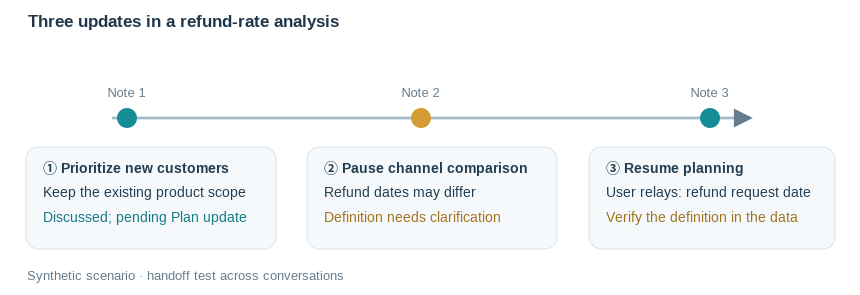
Figure 2. Three discussion updates in the synthetic handoff test.
All three statements deserve preservation, but not the same treatment in the next analysis. General methods can be applied through Agent Skills when relevant. Specific findings and constraints should be retrieved when referring back to or reproducing a particular analysis. The most valuable step in knowledge capture is deciding what should carry forward, and how far.
Today Lantide already links analytical assets, execution evidence, and decision history within workspaces. The next direction is to use those workspaces as structured sources for a reviewed layer of organizational knowledge. A concise entry can provide the definition or method people need, with references back to the original work when it is time to revisit it. New analysis can then supply new evidence for revising that entry.
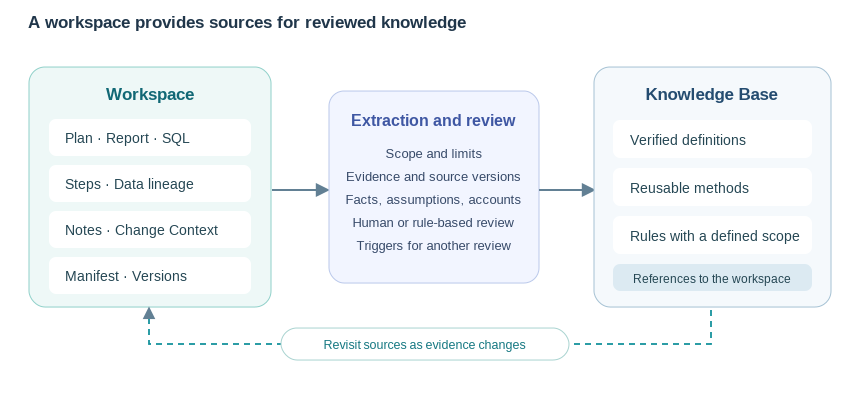
Figure 3. A proposed workflow for deriving reviewed knowledge from a workspace.
When knowledge accumulates alongside work, it has a better chance of evolving with the business and its decisions.
Interested in human-agent collaboration and analytical knowledge? Partner with Lantide.